| PRESIDENT | TREASURER | CHAPTER ADVISORS |
| Steve McCabe | John Szymkowicz | Joe Fanara, Danny Marso, Ken Harpin |
Ken’s Suspended Monorail Setup!
After many weeks of hard work and more than a little help from some friends, I have fulfilled my vision for my Monorail set: suspended from the ceiling above my layout!
Here is how it happened. I started by studying the standard setup of the monorail set. Cursory research suggested that only a handful of people have ever suspended the monorail “upside down” from the usual method– and none had required extending the vertical hangars. I was going to have to invent my own novel solution.
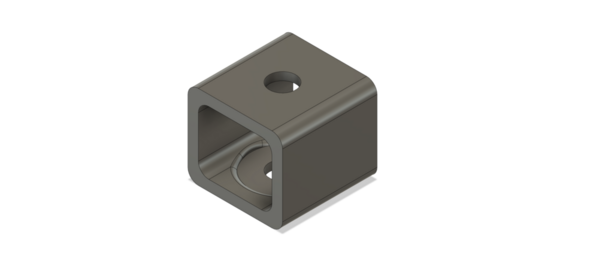
After brainstorming with some friends on a trip to the Big E, we came up with the idea of attaching the vertical hangars to some kind of coupling to a threaded rod. I didn’t like the couplings that I was able to find online, so I designed and fabricated my own. After a few days of prototyping, I had a simple part that I was happy with. Easy to print, functional, strong enough to carry a few pounds weight. The coupling is a “U-joint” with about 45 degrees of flexibility to allow the track sections to be fitted together.
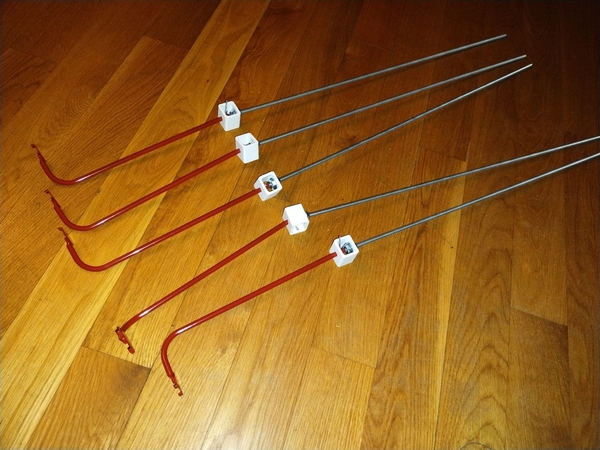
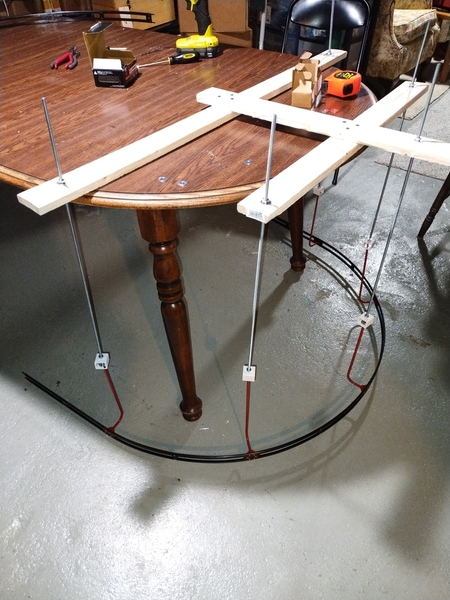
Here’s what the assembled, extended hangars look like. 1/4-20 threaded rod is very similar in diameter to the hangar, so that’s what I used. The monorail hangars are held in place by a washer and cotter pin. In theory, having a longer rod would allow you to use any of the hangars– even the short ones from the crossover set– but later on my decision to use mix-and-match hangars would introduce new challenges.
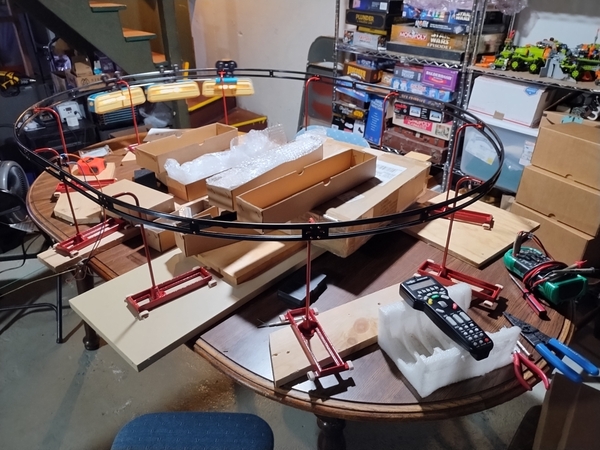
I decided that lining up the curved sections in situ on the ceiling would be too difficult, so I built frames and predrilled the holes for them. Here’s what the corner section looked like when I tested the fitment. Note that the diameter of the track is around 42-43″, but unlike regular tubular track, the radius is held in compression when fully assembled.
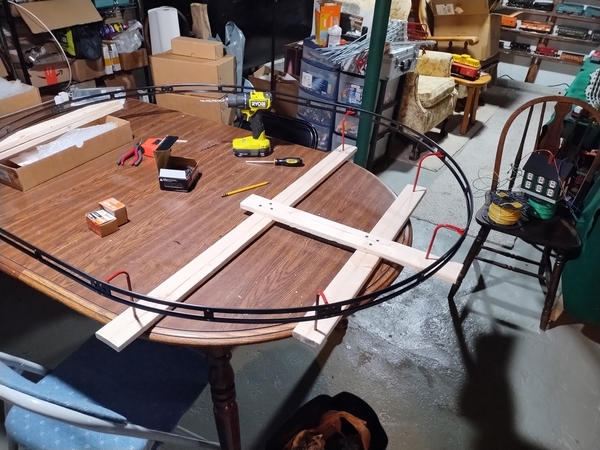
The test build of the corners looked OK and proved that the concept would work. Take note of the nut and washer at the top– the height of the monorail from the layout surface is set by loosening or tightening the top nut. I chose to install the monorail with the threaded rods backed up all the way, and ended up lowering them down as far as they would go.
Preassembling sections took a week and a half’s worth of evenings, but the REAL work was hanging them all up. Working over the existing layout was a challenge, as was getting and then KEEPING everything as straight and even as possible. We spent a LOT of time sighting down the sides of the monorail track as we worked, tapping and prying to get things close to true.
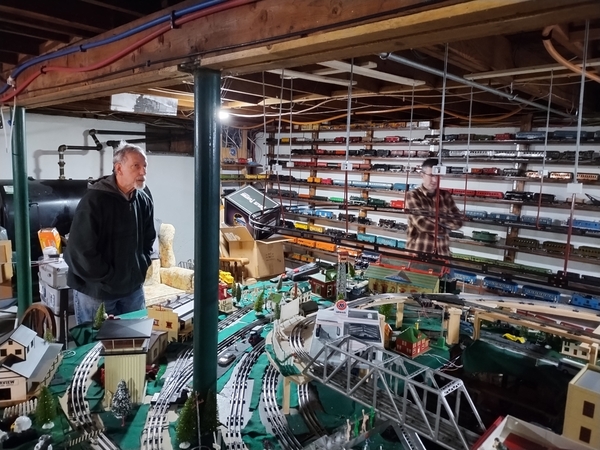
After a solid days’ work, we had all but two sections hung up!
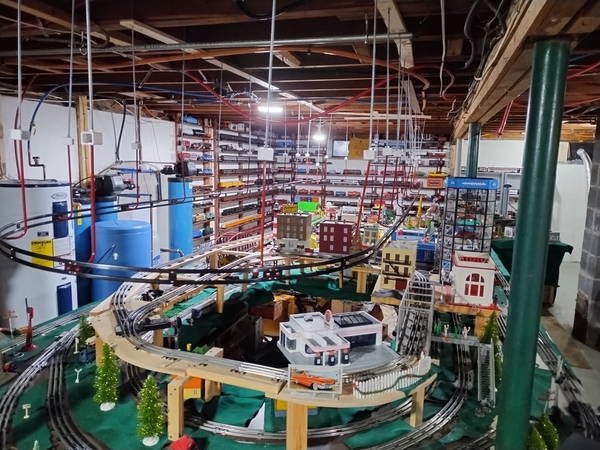
The two sections in question were problematic because the top of the threaded rod was centered on doubled-up joists. I sketched out an idea for a solution using some of the 1×3 scraps leftover from the project. I needed to add a couple extra inches so I could straddle the joists.
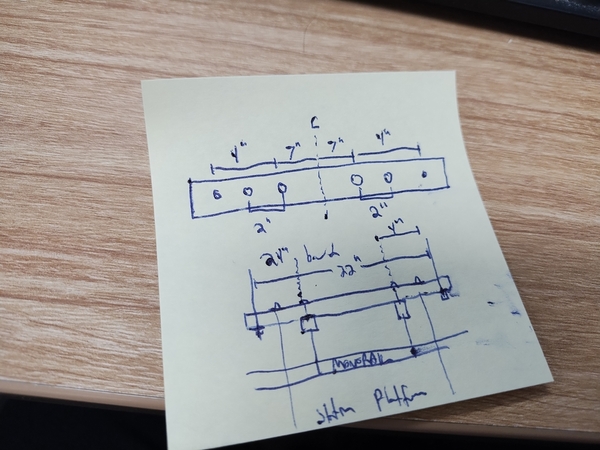
The design worked quite well! With the entire track anchored to the ceiling, I could begin the process of lowering the monorail down to its final height. This took a few evenings of work.
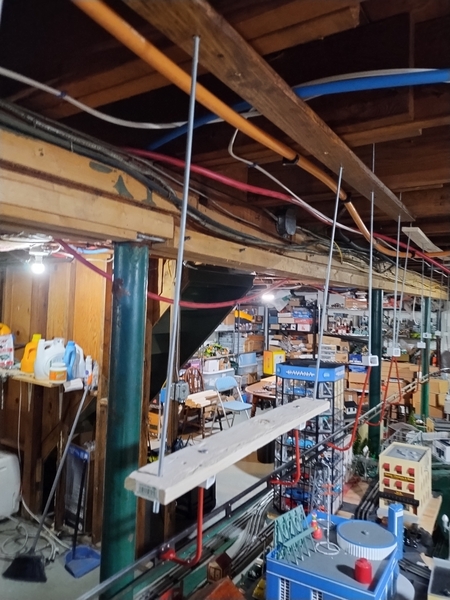
I also had to feed power to the upper deck. I rigged up a scrap 1×3 support onto a piece of the main layout’s benchwork and fed the power in at a 90-degree angle to the track.
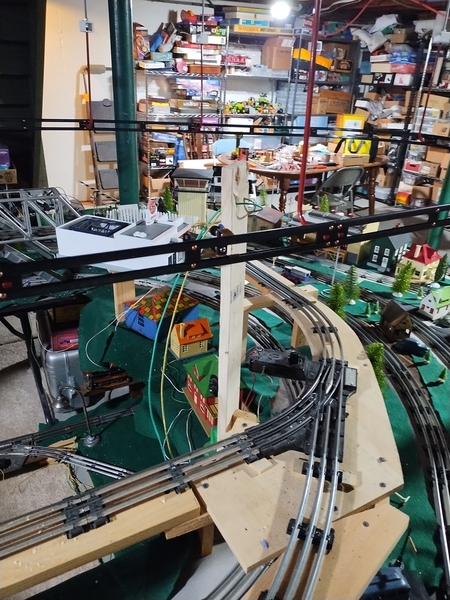
Seeing the monorail in place gave me new ideas! I dreamed of hanging additional benchwork sections from the support structure.
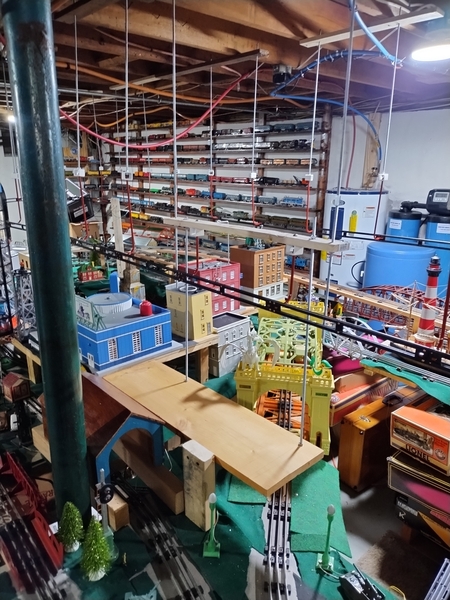
Like most of my idle dreams, new solutions created new problems. The threaded rod posed a collision hazard for the counterweight on the power car. I was able to adjust the structurally critical rods to clear the monorail, but the hanging benchwork section did not pan out. I had to extend a few of the threaded rods with 12″ additions to lower them far enough.
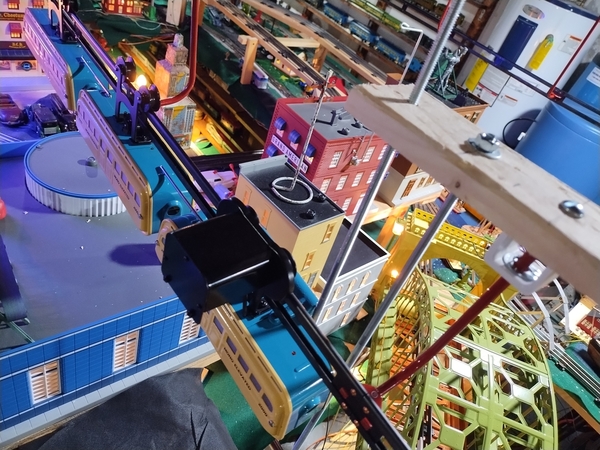
Finally, FINALLY, I was ready to roll!
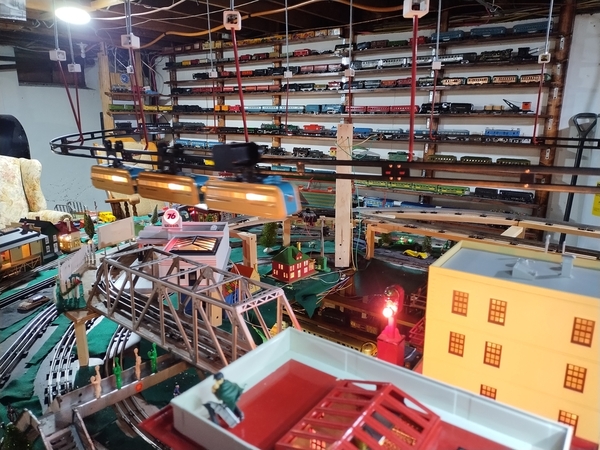
Here’s a longer video showing the inaugural run of the monorail around downtown on my layout.
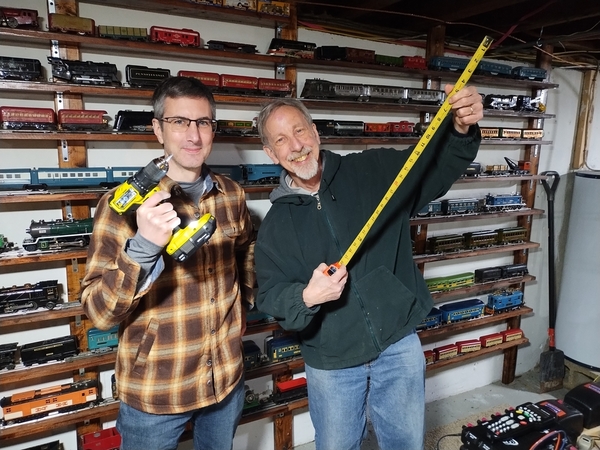
I must give a special shoutout to my friends John and Bill! Without their technical expertise and willingness to help, I’m not sure how I would have pulled this off.
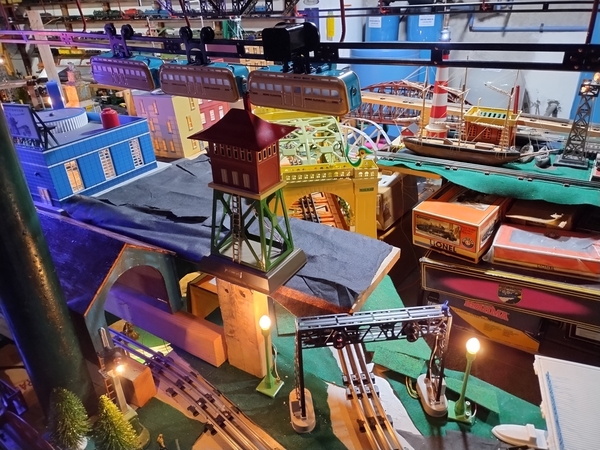
After finishing the monorail, I have been moving forward on a remodel of the layout to complement the new addition. I was able to squeeze in a triangular piece of benchwork to extend the downtown section. I have been hunting down particular structures that fit my vision of what this new real estate will look like.
By Ken Harpin, Southern New England Chapter TCA